
#Systems and adapters
Adapters connect a process to an external system over HTTP, webhooks, GraphQL, email or an LLM provider.
Everything a process does outside Chester goes through an adapter. You define them once under Systems, and every process can then use them without repeating the connection details.
#What you can do here
- Describe an external service, and how Chester connects to it.
- Define the individual operations a process can call — create a ticket, fetch an invoice.
- Point the same operation at a different server per environment.
- Let an external system start a process, by receiving a webhook.
- Connect the language model an agent runs on — see Connect an LLM provider.
#How it fits together
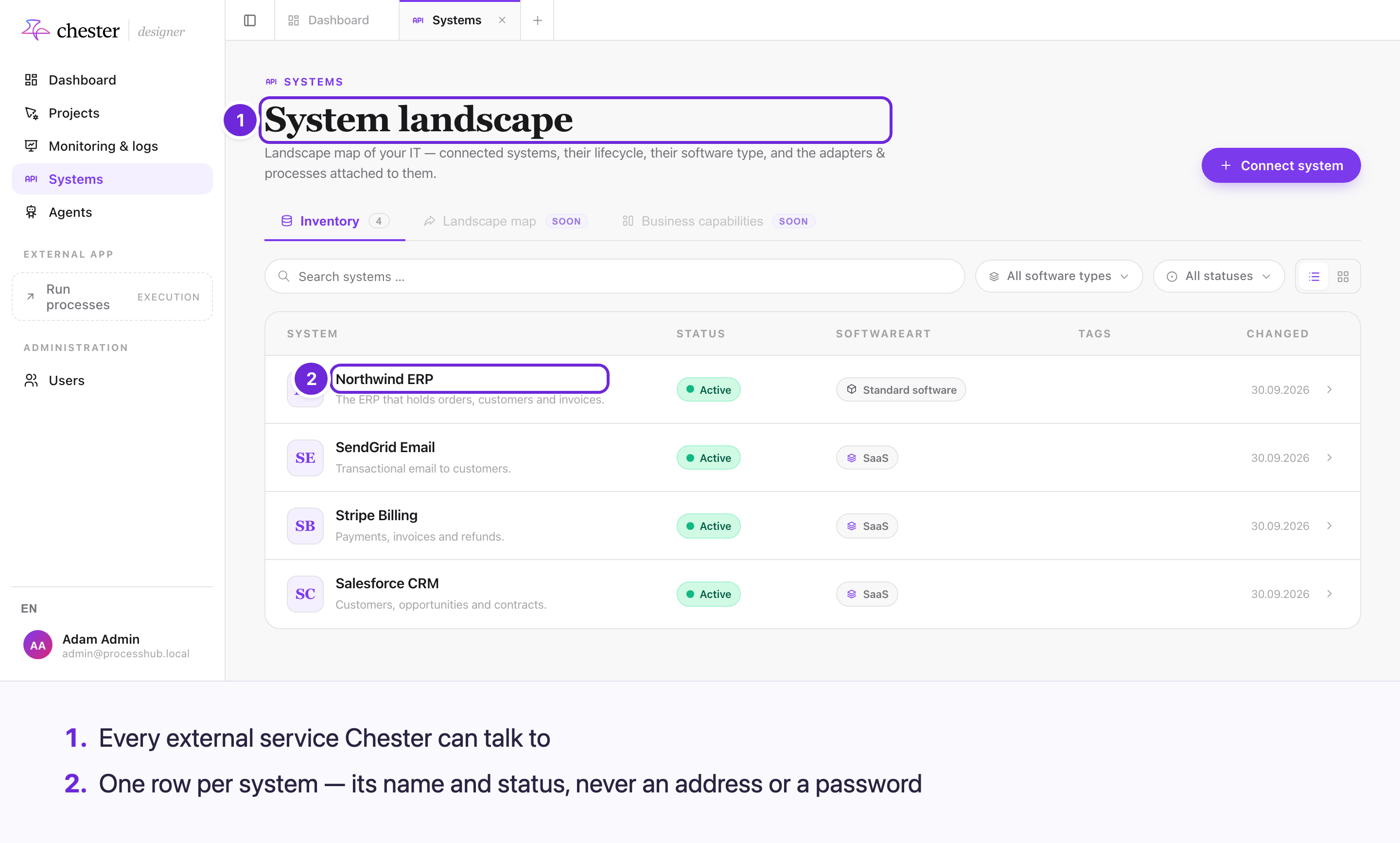
Three levels, and keeping them apart is what lets one definition serve every process: a system is the service itself, an adapter is one way of connecting to it, and an action is a single operation that adapter can perform.
A system is the service itself — a name, a logo, some tags. It holds no address and no password. An adapter is one way of connecting to that system, and a system can have more than one. An action is a single operation the adapter can perform.
Read Systems, adapters and actions for how to create each one. For the actions themselves: HTTP actions, GraphQL actions, inbound actions and schemas and transformations.
#Where the address and the password live
For HTTP, GraphQL and webhook adapters: not on the adapter. A system has environments, and each environment carries the base URL and the credential for that server — production, test and development can be the same adapter pointed at three places.
The exceptions: an email adapter keeps its mail server and login on the adapter, and a static-URL webhook keeps its API key and signature secret there.
Which environment a step uses is chosen while modelling and frozen into the deployment, so it is part of the process rather than something selected when an instance starts. See Environments and credentials.
#Directions
An adapter has a direction, which follows from its type — you pick the type, not the direction:
| Direction | Who calls whom | Typical use |
|---|---|---|
| Outbound | Chester calls the external system | Create a record, fetch data |
| Inbound | The external system calls Chester | A webhook starts or continues a process |
| Signal | An event without a direct caller | Broadcast to waiting processes. ⚠️ Cannot be created in the Designer — see signal events |
The types: HTTP / REST and GraphQL are outbound, HTTP Inbound / Webhook is inbound, E-Mail (SMTP) and LLM provider are outbound without actions.